
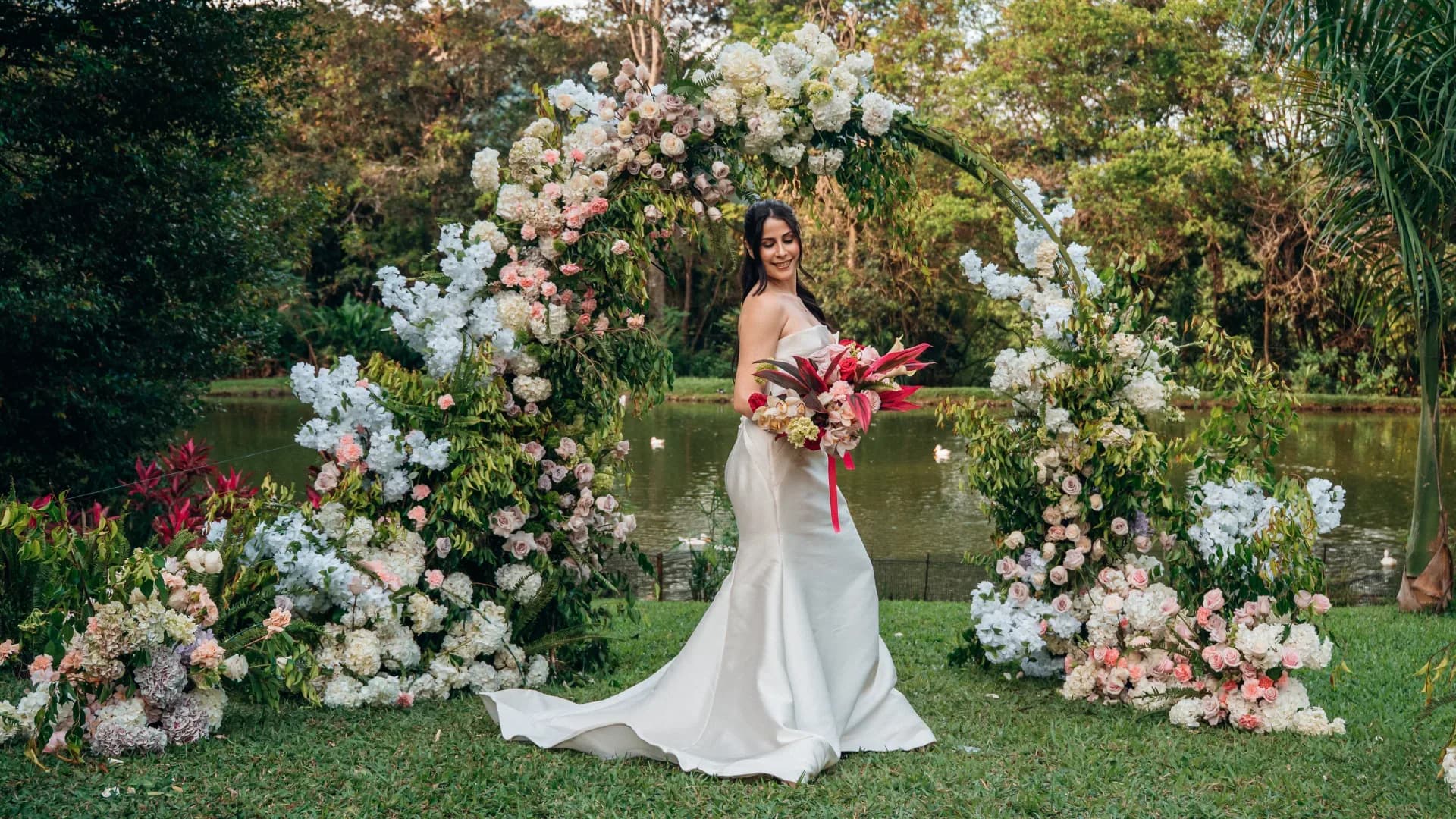
How to Plan a Destination Wedding in Colombia, Step by Step
Planning a wedding starts with a clear sequence: set your budget, decide what kind of celebration you want, and estimate your guest count before you visit a single venue. For a destination wedding in Colombia, two more belong at the very front: how your guests will travel, and which legal documents your marriage will need.
When a couple tells me they do not know where to start, my answer is always the same. A wedding is one of the most meaningful days of your life, and it becomes overwhelming when every decision is made in isolation. Planning well is not about controlling the uncontrollable — it is about anticipating, prioritising, and building a team that can respond.
Set a realistic budget — including the parts nobody quotes you
Have an honest conversation about how much you can invest and where the money comes from. The budget has to cover more than the visible services: taxes, transport, setup and teardown, overtime hours, lodging, gratuities, contingencies — and, for a destination wedding, flights and accommodation for you and anyone you are covering.
Set aside a contingency percentage. It keeps one unexpected adjustment from destabilising the whole project — and with an international wedding, currency movement between quote and payment is one of those adjustments.
Decide the type of wedding and roughly how many guests
Before touring venues, decide whether you picture something intimate, mid-sized or large; religious, symbolic or civil; daytime or evening. Guest count drives venue capacity, catering, transport, furniture and staffing. You do not need a final list yet — you need an honest range. For a destination wedding, assume a share of your list will not travel, and plan for the realistic number rather than the invited one.
Choose destination, venue and date
The venue has to match both your style and the logistical reality of the event. Check access roads, parking, nearby lodging, sound restrictions, curfews, electrical capacity, restrooms, kitchen facilities, a rain plan and setup times. If the ceremony is religious, confirm that ceremony and reception can be coordinated without an impossible transfer between them.
For Colombia specifically: check the rainy seasons for your region — they differ between the Caribbean coast, Antioquia and the Bogotá savanna — along with local holidays and flight availability. Medellín and Cartagena both have international airports, which matters more to your guest list than it may seem.
Build a deliberate guest list
The guest list is often the most sensitive part. Balance what you want against family expectations, and remember that every guest is both a cost and a logistical need. A useful question: is this person part of our life, and do we want to share this moment with them? Defining criteria up front prevents impulsive decisions. With a destination wedding the stakes are higher — you are asking people to spend on flights and time off, so a smaller, deliberate list is often the kinder one.
Hire a planner who will tell you the truth
Look for a planner who can translate what you want into a plan that is actually possible. Their job is not to promise everything — it is to be honest about costs, timelines, risks and alternatives. They coordinate budgets, contracts, the timeline, vendors, setup, protocol, guest care and contingencies. Trust comes from clear communication and responsible handling of your money.
If you are planning from abroad, this is the single most important hire you will make: someone on the ground who knows the region, the vendors and the seasons, and who can run site visits so you do not have to fly in for every decision.
Choose vendors on capacity, not just on their feed
A beautiful Instagram is not operational experience. Review portfolios, references, contracts, response times, team size and their real capacity for an event your size. Photography, video, catering, music, production, décor, hair and makeup, transport and stationery all need to work under one direction. Pre-event meetings are where trust is actually built.
Design a ceremony that means something
The ceremony is the heart of the wedding. Timing, the direction of the sun, music, vows, readings, who officiates and how each person enters all deserve careful thought. Not everything has to be grand — a family gesture, one song, or a few well-chosen words often produce the most moving moment of the day. The exit deserves design too.
Make the invitation do real work
The invitation is the first experience of your event. Beyond the design, it needs date, time, exact location, dress code, transport information, lodging recommendations, RSVP and a channel for allergies or dietary restrictions. For a destination wedding a wedding website earns its keep: flights, airport, visa notes, weather, currency and what to pack all live there, so the printed piece stays beautiful instead of becoming a manual.
Design the menu and do a full tasting
A tasting should evaluate flavour, temperature, presentation, portion size and service timing. Account for where your guests are coming from, religious restrictions, allergies and vegetarian or vegan alternatives. The menu has to be delicious and also viable to serve consistently to your full headcount — those are two different questions.
Have a real weather contingency, not a hope
An outdoor wedding needs an actual alternative, decided in advance: where the ceremony moves to, who makes the call, at what hour the switch is triggered, and which elements need protecting. Tents, flooring, umbrellas, ventilation, heaters or a covered hall belong in the budget from the start, not in a panicked conversation the morning of.
Design the entertainment as a curve
Music should follow the arc of the night. The ceremony might want strings or something intimate; cocktails want a social atmosphere; dinner needs a volume people can talk over; the party should build. Band, DJ and technical production all need to share one timeline, or you get awkward gaps and repeated moments.
Décor is composition, not coverage
Effective décor is not about filling every space. It works with the architecture, the scale, the light and the budget. Flowers, furniture, linens, candles, scent, stationery and signage should read as one system. Small details land hard when they are well placed: a cared-for restroom, a personalised card, a welcome table, warm lighting.
Respect setup and teardown times
Logistics start long before guests arrive. Every vendor needs schedules, access, power points, loading zones and enough people. Teardown deserves the same precision — returning the venue in good condition and avoiding losses. And feeding, hydrating and keeping your crew safe is not optional.
Pack an emergency kit
Thread, needle, safety pins, tape, tissues, stain remover, approved painkillers, plasters, chargers, hangers, touch-up makeup and a small sewing kit solve a surprising number of problems. One person on the team owns the kit — never the couple.
Keep communication centralised
Decide who approves changes, how documents are shared and which channel you use. Important decisions go in writing. On the day, vendors should not be asking the couple about every detail — the planner filters, decides within what was agreed, and protects your peace. Across time zones this matters even more: agree on response windows before you need them.
Enjoy the process
Planning should produce good memories too. There will be changes, limits and tense moments, but a good attitude and a team you trust make it enjoyable. On the day, let go of control and live it. Even unexpected rain becomes part of a beautiful story when the preparation is there.